We read the public record. We send you what matters.
The data is public. The reading is the hard part. Filings are scattered across hundreds of agency portals, in formats designed to be ignored. We read. We sort the noise. We surface what matters to the people who actually work the domain. Nonprofit grantmaking patterns, foundation capacity shifts, and cross-state giving flows; commercial real estate permits, zoning shifts in council minutes, and developer filings; environmental enforcement actions, violations, and cleanup orders. More on the way. Each domain ships as its own email digest — three to five Gleanings per issue.
A Gleaning is something that was always there. Nobody bothered to look for it.
Every issue contains three to five Gleanings. Each one has the same three parts.
A verifiable observation, traced to a primary public-record filing.
What makes that fact worth extracting from the noise this week.
Framed in the sector's own vocabulary, so a reader never has to translate.
Here’s one from a recent Nonprofit issue.
Complete as published — we don’t tease. This one’s from the Nonprofit digest; every sector frames its own.
Wiregrass Foundation — a recurring $1M grant, hidden in a small-grant funder
Fact. The Wiregrass Foundation, in Dothan, Alabama, has directed $21.3M across 604 grants to Alabama organizations — a high-volume funder whose typical grant runs under $7,000.
Signal. Against that pattern of small, frequent checks, one line keeps recurring in its filings: $1,000,000 to the City of Dothan for the “Wiregrass Public Safety Center” — in 2018, 2019, 2020, 2022 and 2024, plus $500,000 in 2025. A single civic project drawing roughly $5.5M from a funder whose median grant is $6,862.
Relevance. For an Alabama grant writer, Wiregrass reads as a broadly accessible in-state funder — 604 grants at a sub-$7K median — that will also concentrate major, sustained capital on a local priority. That pattern is only visible if you read the whole filing history. That’s the work gleantree does.
Five sectors. One shipping, four more on the way.
Each sector we cover gets its own digest, framed in the vocabulary that domain’s readers already use — and where the data rewards digging, a Workbench too. One is live, four are in the pipeline.
When a Gleaning makes you want to dig.
Every sector ships a digest. Where the data rewards hands-on digging, a sector also gets a Workbench — and Nonprofit’s is live today. Point it at your organization and it surfaces the funders most likely to give to an org like yours — ranked, with the grant-history evidence behind each match — and every name in your digest links straight to its page.
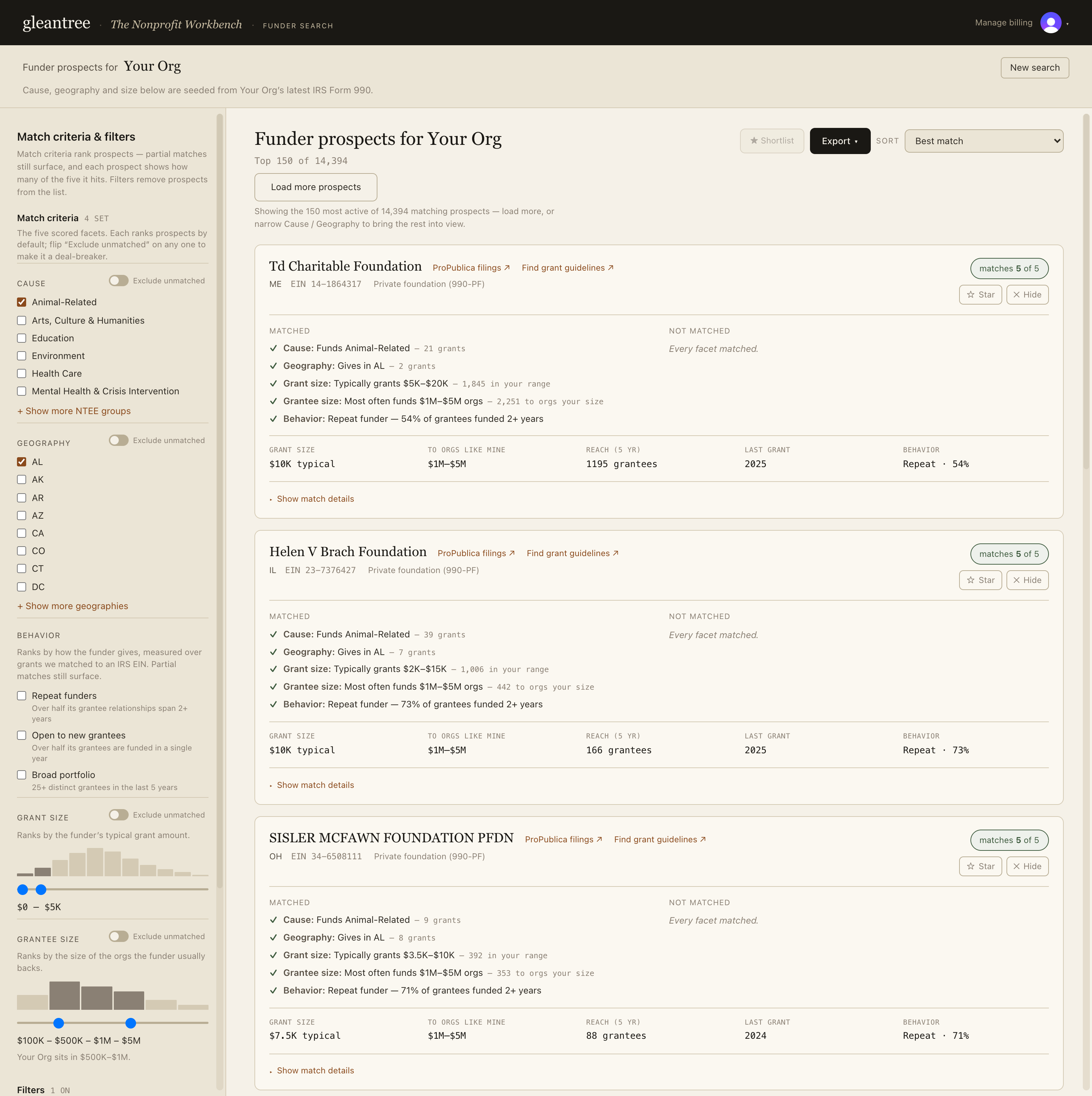
The funders that actually fit — with the reason why.
Point the Workbench at any of 1.8M+ nonprofits and it ranks the funders most likely to give: it reads each foundation’s grant history, mission area, typical check size, and giving geography, then matches them against your organization’s profile. Every match comes with its evidence — the prior grants, the overlapping focus areas, the in-state or cross-state pattern that put it on the list — so you’re starting a conversation with context, not cold-calling a name off a rank. Filter by state, grant range, or cause area, and trace any funder straight to its underlying 990.
We started with nonprofits because the public record there is enormous and almost nobody reads it cold. The digest sends you the handful of 990 filings each week that change who you should call — and the Workbench is there for the morning you want to pull the thread yourself, with every funder traced back to the filing it came from.
Pick what you’ll read.
Available today: the Nonprofit Intelligence digest — free, weekly, for any of 50 states or 26 cause areas. Commercial Real Estate (Birmingham) is coming soon.