This note led the August 2, 2026 nonprofit digest.
Follow the money
For three weeks we've been reading a nonprofit's own 990 — its finances, its pay. This week, turn the form around: foundations file too, and a foundation's 990 lists every grant it made — who got the money, and how much. A funder's website tells you what it says it cares about. Its 990 shows you where the checks actually went.
And you don't need a famous name for this to pay off. Take the two small foundations in the figure below. One is a telephone co-op's foundation in Albany, Minnesota, whose ten checks — $2,500 to $100,000 — fixed a boiler, a parking lot, and a park bathroom, and helped renovate a school building, all within a few miles of town. The other is a family foundation giving to land conservation and colleges up the South Carolina–Tennessee corridor. Ten checks each, and you know exactly who they are: what a typical ask looks like, what they fund, and where. If your work sits in a funder's footprint, that one page is your prospect research.
One honest wrinkle before you go pull filings: the grants page lists recipients by name only — no ID numbers — and sometimes a name can't be matched to any filing. Churches and their schools often don't have to file at all, so there's no filing to find. And some entries are program names, local chapters, or old legal names — "Clemson Univ Foundation Engaged Aging" is the Clemson University Foundation, but you have to know that to see it. The dashed lines in the figure are exactly those grants: real money, real recipients, just no filing to match them to. Nothing's wrong when you hit one; the receipt is written in the funder's own hand.
The lens this week: a funder's grant list is a self-portrait — read it for the pattern, not any single line. Check sizes, causes, places, and whether the same names come back year after year. That's also a preview of next week: matching thousands of hand-typed names to real organizations is exactly the tedious work gleantree does under the hood — and it's how the Workbench connects funders to the causes they fund. If there's a funder you've always wondered about, reply with the name — I read every one.
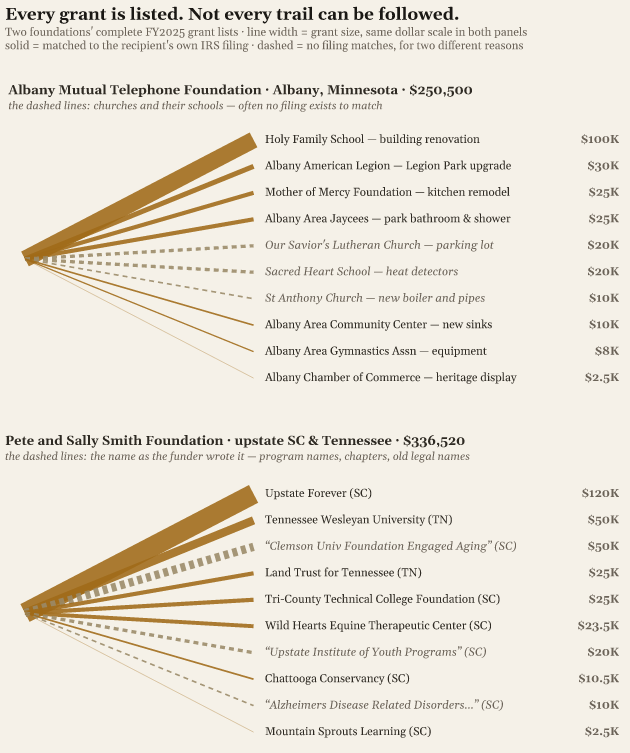
IRS Form 990 filings, FY2025.