This note led the July 19, 2026 nonprofit digest.
Reading the money
Last week I called the 990 a nonprofit's financial portrait. This week, how to actually read one — because the number most people reach for first tells you less than they think. Open almost any nonprofit's filing and the instinct is to hunt for "overhead": the share of spending that goes to admin and fundraising instead of programs. Lower is better, the thinking goes. That's not wrong, exactly — but it's a long way from the whole story.
Here are two nonprofits that make the point, both in child and family services. The first is a mid-sized family-services agency in Iowa; the second is SOS Children's Villages Florida. By the overhead test they're twins: both spend right around 80 cents of every dollar on programs, year after year — and some years the first one scores better. If overhead were your measure of health, you couldn't tell them apart.
Now look at what overhead ignores completely: the cushion — how many months an organization could keep its doors open if the money stopped coming in. Line the years up and the two are mirror images. The family-services agency ran quiet deficits year after year; its revenue looked perfectly normal the whole time, but its reserves drained from nearly nine months of expenses down to under two. No single filing looks alarming — the danger only shows up across the years. SOS Children's Villages went the other way, banking small surpluses until its cushion grew from five months to nearly two years. One of these organizations is a lost grant away from crisis. The other is built to last — and overhead sees no difference between them.
So that's the lens I'd offer: reserves and direction, not ratios. A nonprofit running a modest surplus isn't hoarding — that's exactly how a cushion gets built, and the healthiest organizations often look a little boring on paper. When something in the financials genuinely deserves your attention, it's usually one of these — reserves draining year after year, or revenue leaning too hard on a single source — not the overhead line everyone fixates on. Next week: what a 990 says about pay, and how to read it without jumping to conclusions.
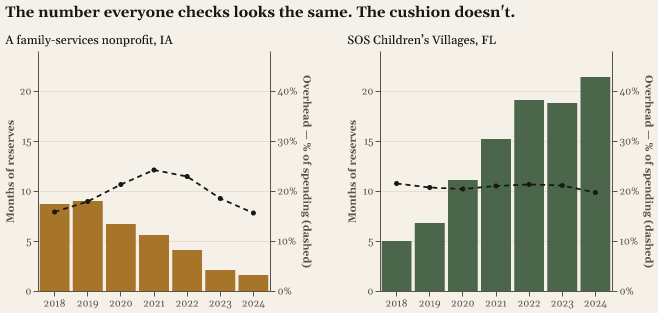
IRS Form 990 filings, FY2018-FY2024.