This note led the September 20, 2026 nonprofit digest.
Your year and your funder's year are not the same year
Here's something nothing in a 990 announces: nonprofits don't all keep the same fiscal year. About two-thirds of the sector closes its books on December 31, and a solid fifth closes on June 30 instead. Two peaks, not one — and the two populations sit in them very differently. Among foundations that made grants in fiscal 2024 — the most recent year we have a complete set for — four in five close in December. Among operating nonprofits it's fewer than two in three. Look at June and the gap is starker: more than one in five nonprofits ends its year there, against one in twenty funders. The sector's second-biggest month is one the funders have largely skipped.
That matters the moment you compare anything. A June-year organization's "2024" ran from July 2023 through June 2024; a calendar-year foundation's ran January through December. Two different twelve-month windows with six months of daylight between them — enough to put a bad quarter in one and not the other. The same goes for peer benchmarking: roughly one in three of the organizations you'd measure yourself against isn't keeping your year. In education, where a majority are off the calendar year, it's more likely than not.
It also decides when you get to see any of it. A 990 doesn't become public when the year ends — the IRS makes it available a median of eight months later for a December filer, ten for a June one, and it then stays the newest thing on file until the next one lands. You can watch that happening in fiscal 2025 right now: the June filings are essentially all in, while the December ones are only about half there and won't be complete until near the end of this year. So the typical December-year funder's newest filing covers the year ending December 2025 — about eight months back — while the typical June-year funder's covers the year ending June 2025, fourteen months back. The same fiscal year on the label, six months apart in fact, and one of them half a year staler. The ordering shifts as the year turns, but the habit shouldn't: check not just whose year you're reading, but how long ago it closed.
What none of this tells you is when anyone decides anything. A 990 is an annual document; it records what a year contained, not what month a check was written, and I'd be making it up if I told you a December-year funder decides in December. The narrower and more useful version: their year and your year are different objects, arriving at different times. So when we compare two organizations' data for a given year, it's important to remember that we're not always comparing the same time period.
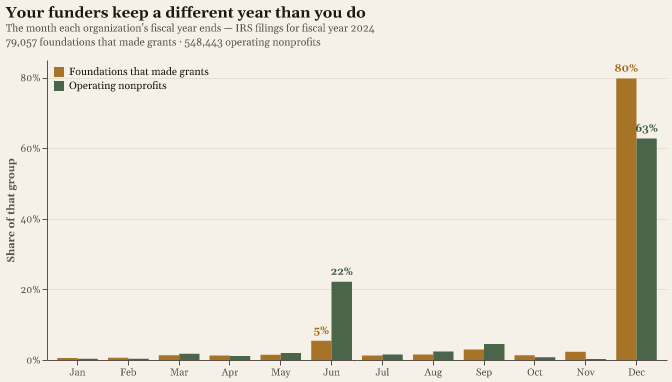
IRS Form 990 filings, fiscal year 2024.