This note led the August 9, 2026 nonprofit digest.
Finding your funders
Ask any grant writer how prospect research actually happens and you'll hear some version of the same thing: a search engine, a borrowed prospect list two years stale, a board member who "knows someone." There's a source that rarely makes that list: the public record — the grant lists we read last week. For prospecting, it's a rich and mostly untapped vein: a running record of which foundations have funded work like yours, in check sizes you'd recognize. The reason nobody taps it isn't that it's hidden. It's that reading it one funder at a time costs a week you don't have.
So that's what gleantree does: we read them all. Every grantmaking foundation's list, every year, with each hand-typed name matched to the organization behind it — the same careful matching you saw in last week's dashed lines, done across the whole country. And once the lists are matched, the question flips. Instead of asking "what does this funder fund?" you can ask "which funders fund work like mine?" — your cause, your state, checks the size you actually ask for. That flip is the whole idea, and it's what the gleantree Workbench is built for. It's in free Beta — and as of this week, the Beta is open: no invite needed, just create an account and try it on your own organization.
Here's how a search goes. Say you run a small arts-and-culture nonprofit in Alabama — an "A" in the IRS's NTEE cause coding, if you speak that language. You start with your own organization: search by name or EIN, and the Workbench reads your 990 and sets up the search for you — your cause, your geography, a check-size range that fits an organization your size. You can widen or narrow any of it. Back comes a ranked list of funders, each tagged with why it surfaced: funds your cause, gives in your state, writes checks in your range, keeps funding the same grantees for years. From there it's a working session: star the ones worth researching, hide the ones that don't fit, tighten the filters, and export the shortlist when it's ready for your next board meeting. One honest caveat from week two still applies — filings run a year or more behind — but funder behavior moves slowly, and that's exactly why last year's receipt is a good guide to next year's check.
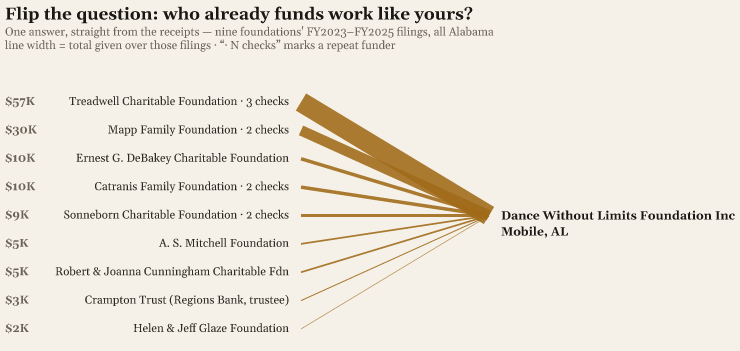
And the figure below shows what that search surfaces. Dance Without Limits Foundation is precisely our hypothetical: a small Alabama arts nonprofit. The nine foundations funding it — every one an Alabama funder, four of the nine writing checks in multiple years — are exactly the matches a search like yours would turn up. A prospect list hiding in plain sight. Six weeks ago this column started with "what's actually in a 990?" — and now you read one the way we do: money, pay, giving, and the connections between them. We're not done with any of it; from here, The Note follows wherever the filings lead. So tell me: what should it dig into next? A funder type, a myth worth busting, a corner of the form we skipped — reply and name it.
IRS Form 990 filings, FY2023–FY2025.